
How Inflation Affects Every Financial Goal You Have
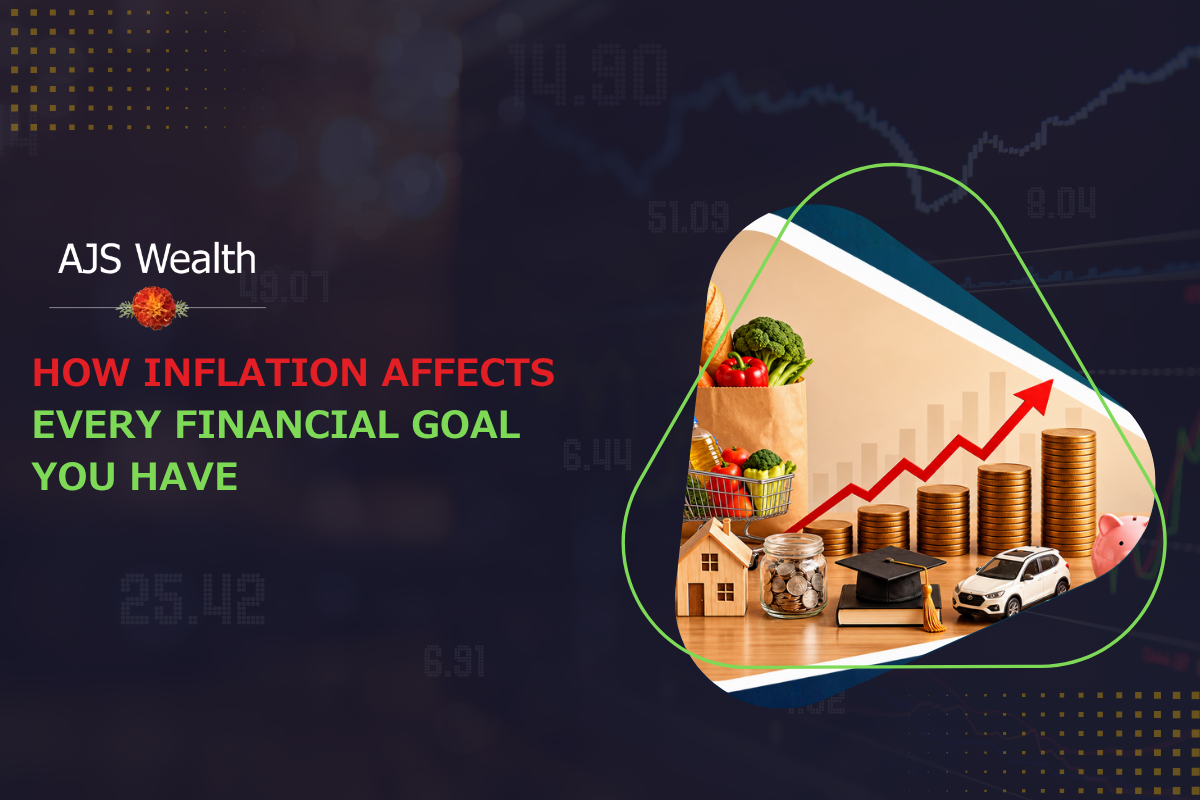
The phenomenon of inflation is an increase in the price level of goods and services. This results in a depreciation in the value of money since more and more money will be required to purchase certain goods and services at the present price level. Simply put, ₹10 lakhs today may lose its purchasing power in a few years. This implies that the effects of inflation can silently impact almost all of your financial targets, including purchasing a house or sending your child to school. The good part is that inflation can be taken into account while planning financially.
What Is Inflation and Why Does It Matter?
The definition of inflation is that there is an increase in price levels over a period of time.
If there is an increase in prices, then there is an increase in the amount of money needed to maintain a certain lifestyle.
So suppose that your expense per month right now is ₹50,000; you might have to pay more money in the future to get those same goods and services.
How Inflation Can Affect Your Financial Goals
- Buying a Home
Acquiring a house is often one of the most important financial objectives for people. Nevertheless, property values, cost of construction, costs associated with maintenance of the property, and so forth can rise in the future. Let us assume that the total cost of buying a home is estimated to be ₹50 lakh currently. In case of acquisition at a later date in the coming years, the total cost can rise greatly. Hence, saving up ₹50 lakh might not be sufficient in case you have such a distant financial objective in mind.
- Your Child’s Education
One more important financial objective on which inflation can have a great effect is education. School and college fees, rent, books, and other related educational expenses may increase in the years to come.
For instance, if the cost of higher education at present is ₹20 lakhs, by the time your child is ready to join college, the requirement would be much greater. That is why one needs to plan for educational expenses rather than waiting for them to arise.
- Retirement Planning
Inflation plays a very critical role in retirement planning because your retirement period is likely to be lengthy.
Suppose that your present expenditure on household expenses is ₹60,000 per month. By the time of your retirement, the amount you will need could be much higher.
The cost of retirement does not end once you retire from your job. Costs of medical expenses, household costs, travel costs, insurance premiums, and others may keep on increasing.
This is why your retirement planning must take into consideration:
- Future cost of living
- Inflation
- Medical expenses
- Life expectancy
- Returns from investment
- Post-retirement earnings
Early retirement planning allows your investments more time to possibly grow.
- Healthcare and Medical Expenses
It is one of the other fields wherein increasing prices can seriously impact your financial plans. Medical consultations, treatment procedures, medications, hospital stays, and other related services may increase in price over time. In this case, the financial plan needs to cover two parts: Good health insurance + proper financial planning for future health care needs.
Insurance will save you from the high prices of medical services, and future investments will help in future.
- Financial Independence
The idea of financial independence implies that you have sufficient finances to sustain your way of life without being fully dependent on the income from your job.
This becomes difficult in the presence of inflation since your needs can change with the passage of time and the sum of money you would need can keep increasing.
Therefore, if you base your financial independence only on your current expenses, you can end up miscalculating the actual figure.
Build an Inflation-Ready Financial Plan with AJS Wealth
This is because inflation may impact every stage of the financial life cycle that you will encounter. AJS Wealth provides investors with goal-oriented financial planning services that include investment planning and wealth creation. By identifying your goals, investment horizons, and risk tolerance level, you will be able to plan a more inflation-friendly approach to build a tax-efficient investment portfolio.